Guide
African women artists you should know
Women artists from Africa have shaped modern and contemporary art from its beginnings: the potter Ladi Kwali, the Algerian painter Baya, the Egyptian painter Inji Efflatoun and the Sudanese painter Kamala Ibrahim Ishaq in the twentieth century; Esther Mahlangu, Wangechi Mutu, Njideka Akunyili Crosby, Zanele Muholi and Julie Mehretu today. This guide introduces fourteen of them.
Updated 3 min read
Pioneers of the twentieth century
Ladi Kwali (c. 1925–1984), Nigeria. Born into a family of potters in the village of Kwali, she made traditional Gwari water jars before joining Michael Cardew's Pottery Training Centre in Abuja (today's Suleja) in 1954, where she learned to throw and glaze stoneware. In 1962 she toured England giving pottery demonstrations; she was appointed MBE in 1963, and she appears on Nigeria's 20 naira note. Her story is told in our guide to African pottery.
Baya (1931–1998), Algeria. Exhibited at Galerie Maeght in Paris at sixteen, with a preface by André Breton; her gouaches of women, birds and gardens are among the key works of Algerian modern art.
Inji Efflatoun (1924–1989), Egypt. A painter and a feminist and Marxist activist, she was imprisoned from 1959 to 1963 for her political ties and kept painting in the women's prison: her fellow inmates, and trees and flowers seen through bars. Those prison paintings are often considered the high point of her work.
Chaïbia Talal (1929–2004), Morocco. Widowed young and working as a maid, she began painting in her mid-thirties after a dream. Supported by the critic Pierre Gaudibert, she exhibited in Paris in 1966, and her vivid, colourful faces made her one of Morocco's best-known painters.
Kamala Ibrahim Ishaq (born 1939), Sudan. A member of the Khartoum School who broke away in 1976 to co-found the Crystalist group. Her paintings of women's faces trapped in glass-like forms were the subject of a major exhibition at the Serpentine in London in 2022–23.
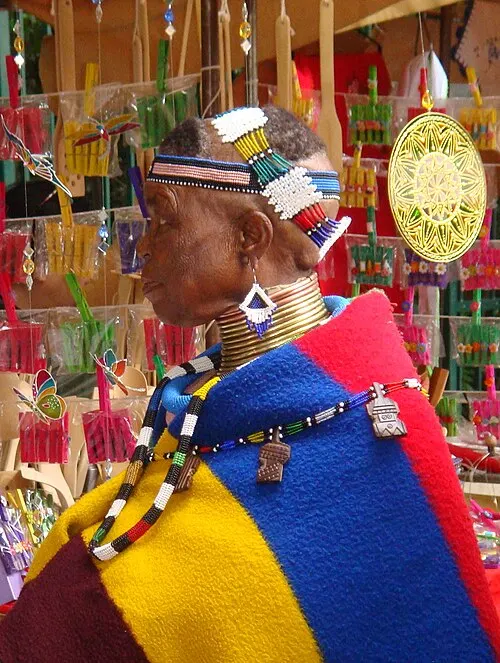
Esther Mahlangu (born 1935), South Africa. The Ndebele painter who took her mother's and grandmother's wall-painting tradition to Paris in 1989 and onto a BMW Art Car in 1991.
Nike Okundaye, Nigeria. A textile artist who emerged from the Oshogbo school workshops and built art centres and galleries that have trained many young artists in adire (indigo-dyed cloth) and other textile techniques.
Contemporary voices
Sokari Douglas Camp (born 1958), Nigeria and UK. Born in Buguma in the Niger Delta and based in London, she makes steel sculpture often drawn from Kalabari masquerade and politics. She was appointed CBE in 2005.
Wangechi Mutu (born 1972), Kenya. Collagist and sculptor; her bronze figures were the first ever installed in the facade niches of the Metropolitan Museum of Art, in 2019.
Julie Mehretu (born 1970), Ethiopia and USA. Born in Addis Ababa and raised in the United States, she paints vast, layered abstractions built from architectural plans, maps and gestural marks.
Marlene Dumas (born 1953), South Africa and the Netherlands. Born in Cape Town and based in Amsterdam, she is one of the most influential figurative painters of her generation.
Zanele Muholi (born 1972), South Africa. A visual activist whose photographs document and celebrate South Africa's Black lesbian, gay, trans, queer and intersex communities. Their series Faces and Phases, begun in 2006, is a living archive of hundreds of portraits; Tate Modern presented a major survey of their work in 2020–21.
Njideka Akunyili Crosby (born 1983), Nigeria and USA. Painter of layered interiors built from photo transfers; MacArthur Fellow in 2017.
Toyin Ojih Odutola (born 1985), Nigeria and USA. Known for intricate drawings in pen, charcoal and pastel that tell invented family histories.
Why this list
Histories of African art written in the twentieth century were dominated by men, and women's work was often labelled "craft" — pottery, textiles, wall painting — rather than art. Several women on this list made their names precisely by refusing that distinction. Many more could be added; this is a starting point.
Related
More women artists have their own profiles on this site, among them the potter Magdalene Odundo, the painter Lubaina Himid, the Senegalese sculptor Seyni Awa Camara, the Egyptian-born artist Ghada Amer, the Egyptian painters Effat Nagy and Anna Boghiguian, the Moroccan artist Yto Barrada, and the Ghanaian leaf-print painter Sharon Dede Padi. See where to find their work in where to see African art, and where new work is shown in African art fairs and biennales. The photographer Khadija Saye, whose tintypes were shown in Venice in 2017, also has her own profile.