Art form
African textiles
Cloth in Africa is wealth, language and art at once. Strip-woven kente and aso oke, Mali's mud-painted bogolan, Yoruba adire indigo, the raffia cloth of the Kuba, East Africa's printed kanga and Uganda's barkcloth each have their own techniques and meanings — and the "African print" wax fabrics sold in every market have a history that runs through the Netherlands and Indonesia.
Published 3 min read
Cloth as wealth and language
Across much of the continent, cloth was stored as wealth, given at weddings and funerals, and even used as money: in the Kongo kingdom, squares of raffia cloth circulated as currency. Cloths carry names, proverbs and messages. Wearing a particular cloth to a particular event says something about the wearer, and about what they think of the occasion.
Strip weaving: kente and aso oke
In West Africa, weavers — traditionally men — work on narrow horizontal treadle looms that produce long bands a few centimetres wide, which are then cut and sewn together edge to edge. The most famous result is Ghana's kente, woven by Asante and Ewe weavers and recognised by UNESCO in 2024. The Yoruba of Nigeria weave aso oke, worn at weddings and festivals, often as aso ebi: matching outfits chosen by family and friends for an event.
Dyed, painted and stamped cloth
- Adire is the indigo-dyed cloth of the Yoruba, with famous centres in Abeokuta and Ibadan. In adire eleko, designs are painted onto the cloth with a cassava-starch paste that resists the dye; in adire oniko, the cloth is tied before dyeing.
- Bogolan, or mudcloth, is Mali's cotton dyed with leaves and painted with fermented mud.
- Adinkra cloth from Ghana is stamped with carved calabash stamps in a black bark dye; each motif carries a meaning (see adinkra symbols).
Raffia: the Kuba of the Congo
In the Kuba kingdom of the DR Congo, men weave squares of raffia palm fibre and women embroider them, cutting the threads to make a soft pile like velvet. The geometric designs, which seem endlessly varied, were admired by European modernists — Henri Matisse kept Kuba cloths in his studio. Long ceremonial skirts assembled from many panels are still worn at funerals and royal occasions.
Printed cloth
Wax print, sold across Africa as "African print" or Ankara, began in the nineteenth century as Dutch industrial imitations of Javanese batik. They found their market in West Africa rather than Indonesia, and the Dutch company Vlisco, founded in 1846, still sells some of the most prized designs; many more are now made in Africa and Asia. Designs acquire nicknames in the markets where they are sold. The British-Nigerian artist Yinka Shonibare uses Dutch wax precisely because its "African" identity is so complicated.
On the East African coast, the kanga — a rectangle of printed cotton, usually sold in pairs — carries a Swahili saying printed along its border, and wearers choose a kanga for its message. The heavier kitenge is used for tailored clothes. In South Africa, shweshwe, a printed cotton originally dyed with indigo, is associated with Xhosa and Sotho dress and is still produced in the Eastern Cape.
Barkcloth
Among the Baganda of Uganda, the inner bark of the mutuba fig tree is beaten into a soft, terracotta-coloured cloth used for royal and ritual dress and for burial. UNESCO recognised barkcloth making in Uganda as intangible cultural heritage in 2005. The Kenyan painter Michael Armitage paints on this cloth today.
Textiles in modern art
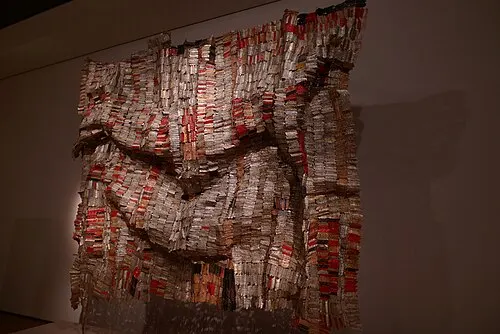
El Anatsui's metal hangings recall woven cloth; the Malian artist Abdoulaye Konaté builds monumental works from dyed textiles; Nike Okundaye of the Oshogbo school has trained generations in adire; and the École de Dakar turned paintings into tapestries at Thiès.
Buying cloth
Ask whether a cloth is handwoven, hand-dyed or machine-printed: all three are legitimate, but they are priced very differently. Seams between narrow woven strips, irregularities and a reverse side that shows the pattern are signs of handwork. See also how to buy African art.
Related
Beads were often sewn onto cloth: see African beadwork. Masquerade costumes are described in African masks, and the cloths of the region in West African art.