Art form
African beadwork
Beads are among the oldest ornaments made by humans, and some of the oldest yet found come from Africa: shell beads about 75,000 years old from Blombos Cave in South Africa. Glass beads that arrived through trade across the Sahara and the Indian Ocean, and later from Venice and Bohemia, were transformed into distinctive arts — Maasai collars, Zulu and Ndebele beadwork, Yoruba royal crowns, the beaded thrones of Cameroon — while Ghana's Krobo makers produce glass beads of their own.
Published 3 min read
Beads before glass
At Blombos Cave, on the southern coast of South Africa, archaeologists found small Nassarius shells pierced and worn as beads around 75,000 years ago. Beads cut from ostrich eggshell have been made in East and southern Africa for tens of thousands of years, and San communities in the Kalahari still make them. Beads, in other words, are not a decoration added to African art: they are among the first art humans made anywhere.
Glass and trade
Glass beads reached Africa through long-distance trade: across the Sahara, and along the Indian Ocean coast, where glass beads have been found in quantity at sites such as Mapungubwe in South Africa, a kingdom of the thirteenth century. From the fifteenth century, European traders brought beads made in Venice and later Bohemia, including the layered "chevron" beads that became a currency of exchange in West Africa. African beadworkers chose the colours and sizes they wanted, and the market followed them.
Krobo beads
The Krobo people of eastern Ghana make beads of their own from recycled glass: bottles and windows are ground to powder, packed into clay moulds, and fired in kilns. The results range from translucent to opaque and are painted or layered in many colours. Beads are central to Dipo, the Krobo initiation ceremony for girls.
East Africa: Maasai and Samburu
Maasai and Samburu women in Kenya and Tanzania make wide, flat beaded collars, earrings, headbands and belts. Beadwork signals age, marital status and occasion, and colours carry commonly cited associations: red for bravery and unity, blue for the sky and the rain it brings, green for land and health, white for purity and milk, orange and yellow for hospitality.
Southern Africa: Zulu, Xhosa and Ndebele
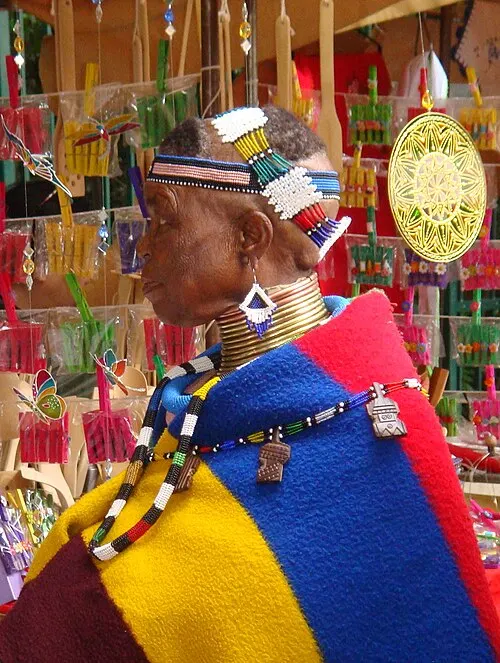
Zulu beadwork includes the small beaded panels often called "love letters", exchanged by young people, in which combinations of colours and patterns carry messages — though meanings depend on region and context more than on any fixed code. Xhosa beadwork favours white, with collars and capes of great intricacy. Ndebele women make beaded aprons, capes and blankets that mark the stages of a woman's life, in the same geometric language as Ndebele wall painting, the tradition of Esther Mahlangu.
West and Central Africa: crowns and thrones
A Yoruba king's crown, the ade, is a cone covered in beads, often topped with birds, with a veil of beaded strands that hides the king's face; only kings with the right to it may wear one. Families of bead embroiderers in towns such as Efon-Alaye made crowns, slippers and staffs for the courts.
In the Grassfields of Cameroon, the Bamum and Bamileke kingdoms covered thrones, figures, calabashes and masks in beads — including the beaded elephant masks of Bamileke societies. The beaded throne of King Njoya of Bamum, Mandu Yenu, given to the German emperor in 1908, is in Berlin.
Beads in modern art
At the Oshogbo workshops in Nigeria in the 1960s, Jimoh Buraimoh developed bead painting, adapting Yoruba beadwork into pictures. In South Africa, beadworkers continue to make both traditional regalia and large contemporary beaded panels, and designers use beadwork on fashion and objects.
Related
Beads were sewn onto textiles and masks. The great Southern African beadwork traditions are described in Southern African art.