Textile tradition · Ghana
Kente cloth
Kente is a handwoven cloth from Ghana, made by Asante and Ewe weavers from narrow strips of silk, cotton or rayon woven on horizontal treadle looms and sewn together edge to edge. Once a prestige cloth of chiefs and royalty, it became a symbol of Ghana's independence and of African heritage worldwide, and in December 2024 UNESCO inscribed the craftsmanship of kente on its list of the intangible cultural heritage of humanity.
Published 3 min read
How kente is made
Kente is woven on a horizontal treadle loom that produces a single narrow band, about ten centimetres wide. The weaver — traditionally a man — works the treadles with his feet to lift sets of warp threads and passes the weft through by hand, building up the pattern in blocks: stretches of warp-faced stripes alternate with blocks where the weft covers the warp in contrasting colours and motifs.
The long band is cut into strips, and the strips are sewn together side by side so that the blocks form a chequerboard across the finished cloth. A full man's cloth, worn wrapped around the body and over one shoulder like a toga, needs many strips, so a single cloth can take weeks or months to weave.
Asante and Ewe kente
Two peoples weave kente, and both have strong traditions:
- Asante kente, from the Ashanti Region around Kumasi, is known for brilliant colours and bold geometric blocks. The weaving town of Bonwire is its most famous centre. The Asante call the cloth nwentoma, "woven cloth"; the word kente is often traced to a Fante word for basket, after the cloth's woven look. Asante tradition tells of two men from Bonwire who learned to weave by watching a spider spin its web. Historically, the finest silk cloths were made for the Asantehene, the Asante king, and certain patterns were reserved for royalty.
- Ewe kente, woven in Ghana's Volta Region and in Togo, often uses cotton and subtler colours, and can include figurative motifs — people, animals, objects — woven into the cloth. Agotime is a renowned Ewe weaving area and holds an annual kente festival.
UNESCO's 2024 inscription names both the Asante and the Ewe as the communities that carry the craft.
Pattern names and colours
Every kente design has a name, often taken from a proverb, a historical event, a person or a social situation. Oyokoman is named after the Oyoko clan, the royal clan of the Asante; Adweneasa, "my skill is exhausted", is a densely patterned cloth in which every block is decorated; Sika futuro, "gold dust", refers to wealth.
Colours carry associations, though they are not a strict code and sources vary. Commonly given meanings include:
| Colour | Common associations |
|---|---|
| Gold or yellow | Wealth, royalty, fertility |
| Green | Growth, harvest, renewal |
| Red | Struggle, sacrifice, political passion |
| Blue | Peace, harmony, love |
| Black | Maturity, the ancestors, spiritual energy |
| White | Purity, celebration, victory |
| Maroon or brown | The earth, healing |
A national and Pan-African symbol
When Ghana became independent in 1957, kente became a national emblem. The country's first president, Kwame Nkrumah, wore it on state occasions at home and abroad, and it came to stand for independent Africa as a whole. In the African diaspora, especially in the United States, kente stoles are now worn at graduations and kente patterns appear on everything from church robes to sportswear.
Handwoven and printed "kente"
Most "kente" sold worldwide is printed fabric that imitates the pattern. A handwoven cloth shows the seams between narrow strips, slight irregularities in the weave, and the same pattern on both sides. Prices reflect the material (silk, rayon or cotton), the complexity of the design and the weaver's reputation. Buying directly from weavers in Bonwire, Agotime and other weaving towns supports the people who keep the craft alive.
Related
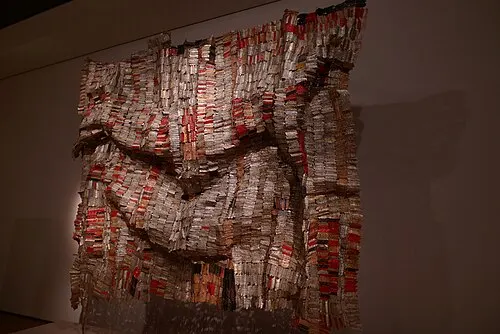
Kente is often worn with, and compared to, the stamped adinkra cloth, the other great Asante textile. For the wider picture, see African textiles. El Anatsui's bottle-cap hangings recall kente's strips and blocks, and Ghana's highlife is the music that played at the independence celebrations where kente was worn.