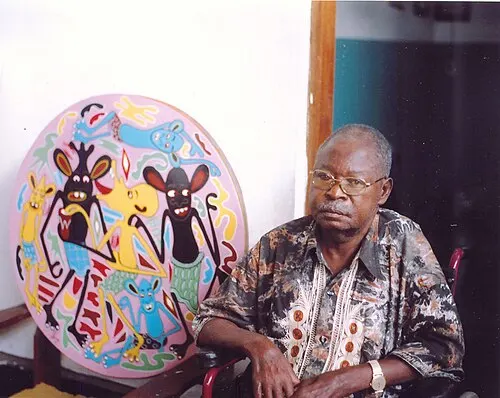
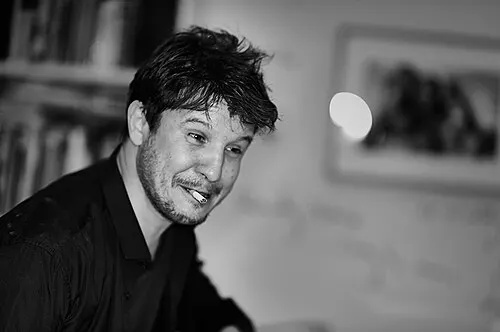
Painter and artist · Tanzania
Lubaina Himid
Lubaina Himid (born 1954) is a Zanzibar-born British artist based in Preston. A leading figure of the Black Arts Movement in 1980s Britain, she paints and makes cut-out figures and installations that bring forgotten Black lives — servants, sailors, workers, women — back into history, often with wit and bright pattern. In 2017 she became the first Black woman to win the Turner Prize, and in 2026 she represents Britain at the Venice Biennale.
Updated 3 min read

Zanzibar and London
Lubaina Himid was born in Zanzibar in 1954. Her father died when she was a baby, and her mother, a textile designer, took her to Britain. She studied theatre design at Wimbledon College of Art and later took a master's degree in cultural history at the Royal College of Art. Theatre and textiles both stayed with her: her work often feels like a stage set, and patterns — especially the printed kanga cloths of East Africa — run through it.
The Black Arts Movement
In the 1980s Himid was at the centre of the Black Arts Movement in Britain. As well as making her own work, she organised exhibitions that gave Black women artists a place they had been denied, among them Five Black Women (1983) and The Thin Black Line (1985). Her A Fashionable Marriage (1986), a cut-out installation that restaged Hogarth's Marriage A-la-Mode with figures from the politics and art world of Thatcher's Britain, is one of the key works of that period. Himid cut Hogarth's painted figures out of the canvas and set them up as a life-size tableau of 1980s London, with Margaret Thatcher and Ronald Reagan in the roles of the countess and the lawyer Silvertongue.
Naming the forgotten
Much of her work looks at the people history left out. Naming the Money (2004) is a crowd of about a hundred life-size painted cut-out figures — servants, musicians, cooks, dog-trainers — representing Africans enslaved in eighteenth-century Europe, each given back a name and a story. The figures are cast in trades and roles, among them ceramicists, herbalists and shoemakers, and a soundtrack lets them speak; Himid presented the installation to the International Slavery Museum, part of National Museums Liverpool, and a smaller group of twenty figures has been shown at the Walker Art Gallery in the city. How to look at it: the figures are given roles and names, so read them as individuals rather than as a crowd, and listen to the soundtrack that speaks for them. Swallow Hard: The Lancaster Dinner Service (2007) repaints a set of old dinnerware to tell the story of slavery. Other works paint over pages of old newspapers to expose the racism of their images, or show Black women talking, planning and working in bright, flat interiors and landscapes. Her paintings use strong colour and pattern, and often humour, to raise serious questions about who is seen and who is remembered.
Recognition
Recognition came late and then all at once. In 2017, aged 63, she won the Turner Prize — the first Black woman and the oldest artist to do so. Her Turner Prize show was staged at the Ferens Art Gallery in Hull, and she was appointed CBE in 2018. Tate Modern opened her largest solo exhibition to date in November 2021, with new paintings alongside highlights from her career; cloth flags inspired by East African kanga textiles greeted visitors. She is a professor emerita at the University of Central Lancashire in Preston, where she lives. In 2026 she represents Britain at the Venice Biennale with Predicting History: Testing Translation, in the British Pavilion; the British Council announced the choice in February 2025.
Where to see the work
The British Pavilion at the Giardini in Venice is open from 9 May to 22 November 2026; the commissioner is Emma Dexter and the curator Ese Onojerou. In Liverpool, ask the International Slavery Museum about Naming the Money. The Royal Academy showed the figures in 2024 in Entangled Pasts, 1768–now, which makes it worth checking what the Academy and Tate currently display.
See also
Tanzania's Tingatinga painting and Makonde art; the Kenyan-born potter Magdalene Odundo; African women artists; contemporary African art; and East African art.