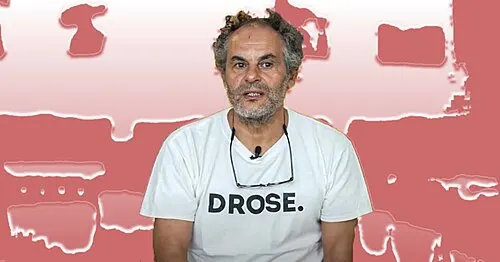
Artist and photographer · Morocco
Yto Barrada
Yto Barrada (born 1971) is a French-Moroccan artist based in Tangier and New York. She became known for A Life Full of Holes: The Strait Project, photographs of Tangier as a place of waiting for those hoping to cross to Europe. She co-founded and directs the Cinémathèque de Tanger, and her later work spans film, sculpture, prints and textiles. She represents France at the 2026 Venice Biennale.
Updated 3 min read

Tangier
Yto Barrada was born in Paris in 1971 and grew up in Tangier, the Moroccan port that faces Spain across the Strait of Gibraltar. She studied history and political science at the Sorbonne, then photography at the International Center of Photography in New York, and went back to Tangier to work.
The Strait Project
Her first major series, A Life Full of Holes: The Strait Project (1998–2004), looks at Tangier at a time when Europe was closing its borders. Spain lies only fourteen kilometres away, but for most Moroccans a visa had become almost impossible to get, and many young people risked the crossing in small boats. Barrada's photographs show the city as a waiting room: empty lots, people turned away from the camera, wallpaper of alpine landscapes, a boy looking out to sea. They are quiet, often oblique pictures about longing, departure and staying behind.
The series was published as a book in 2005 and established her internationally. In 2011 Deutsche Bank named her its Artist of the Year, with an exhibition, Riffs, at the Deutsche Guggenheim in Berlin. The same year Tate Modern in London gave her a solo exhibition.
How to look at the Strait Project: read it as a set of small facts that add up, not as one reportage. Empty lots, a wallpaper of alpine landscapes and a boy looking out to sea each say little alone. Look for what the people in the pictures are not doing: they wait, they look away, they stay. The series was made between 1998 and 2004, in the years when Spain was tightening visas for Moroccans.
The Cinémathèque
In 2006 Barrada co-founded the Cinémathèque de Tanger in the old Cinéma Rif, an art deco cinema on the Grand Socco square. The project began in 2003, when a group of artists and film professionals, Barrada among them, formed a non-profit to take over the lease of the 1938 cinema. It became North Africa's first arthouse cinema and film archive and a meeting place for the city, and she has directed it ever since. Her Album: Cinematheque Tangier was shown at the Walker Art Center in Minneapolis from November 2013 to May 2014.
Beyond photography
Her later work moves freely between film, sculpture, collage, prints and textiles. A 2007 exhibition at Galerie Polaris in Paris was titled Iris tingitana, la botanique du pouvoir, "the botany of power", and shows how far her interests had moved. She draws on archives, botany, toys, natural history and Moroccan modernism, and in recent years has dyed fabrics with plants, a practice she continues at The Mothership, an eco-campus she co-founded on land next to her childhood home in Tangier, where artists can learn to grow plants and make natural dyes. Her work was shown at MoMA in New York and at MASS MoCA in North Adams, Massachusetts, in 2021.
Venice, 2026
In November 2024 the Institut français announced that she would represent France at the 2026 Venice Biennale, succeeding Julien Creuzet. Her exhibition in the French Pavilion, Comme Saturne, curated by Myriam Ben Salah, runs from 6 May to 22 November 2026, so it is open now. The project takes up the Renaissance idea that artists are born under Saturn, the planet of melancholy and slow thought. It combines textiles, film, sculpture and language: visitors walk through draped wool environments, and daylight gradually bleaches the textiles over the run of the show, so the pavilion looks different in November than it did in May. The Mothership is tied to the project as a research site. The catalogue is published by JRP|Editions.
See also
The photographers Leila Alaoui and Hassan Hajjaj; African photography; and our lists of Moroccan photographers and Moroccan artists.