Painter and teacher · Nigeria
Uche Okeke
Uche Okeke (1933–2016) was a Nigerian painter, poet and teacher, a leader of the Zaria Art Society and one of the most influential figures of modern Nigerian art. He articulated the idea of "natural synthesis" — combining Nigerian traditions with modern art — and, at the University of Nigeria in Nsukka, built on the uli body and wall drawing of Igbo women to create a modern art school.
Updated 2 min read
Uche Okeke was born in 1933 in Nimo, in what is now Anambra State, to an Igbo family and studied fine art at the Nigerian College of Arts, Science and Technology in Zaria. In 1958, with fellow students, he founded the Zaria Art Society, sometimes called the "Zaria rebels", who rejected the colonial art curriculum. Okeke gave the group its guiding idea: a "natural synthesis" that would take what was valuable from Nigerian traditions and from the West to make an art for a newly independent nation. His 1960 "Natural Synthesis" manifesto is reprinted in his book Art in Development – A Nigerian Perspective (1982). Read the story in Zaria Art Society.
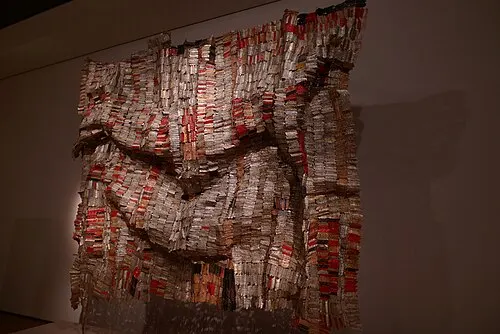
Okeke turned to uli, the flowing line drawings that Igbo women painted on bodies and walls, and to Igbo folklore, which he also collected and wrote about. From 1964 to 1967 he directed the Mbari Art Centre in Enugu. He founded the Asele Institute and Documentation Centre at Nimo, in 1958 or 1959 depending on the source. In 1971 he was appointed professor and head of the Department of Fine and Applied Arts at the University of Nigeria, Nsukka, where he made uli the basis of a modern school of drawing and painting; among those associated with Nsukka were El Anatsui and Obiora Udechukwu.
How to look at an Okeke: follow the line. Uli drawing is a line that curves, branches and returns, and in his work it carries the figure and the ground at once; the shapes are simple and the movement is in the contour. That reading is this site's own.
He died in Nimo on 5 January 2016 (the National Gallery of Nigeria gives 6 January).
Where to see the work
The Princeton University Art Museum lists his work, and the National Gallery of Nigeria publishes a biography; the Asele Institute in Nimo is the place connected with his own practice, so ask there about visits. See also Bruce Onobrakpeya, El Anatsui and our list of Nigerian painters.