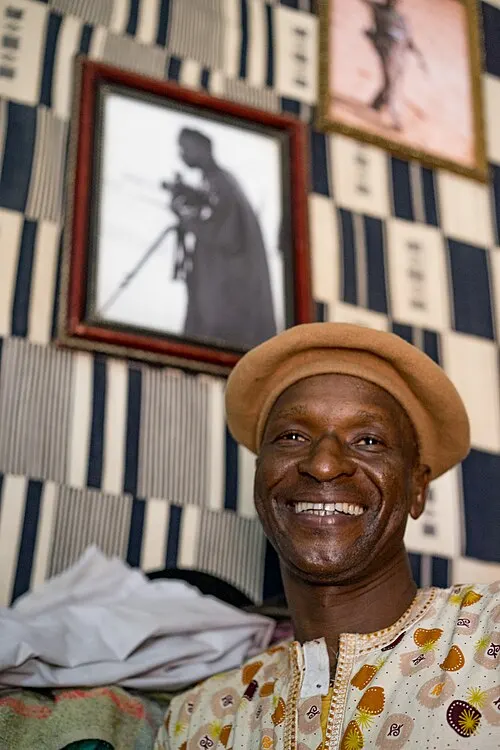
Photographer · Mali
Seydou Keïta
Seydou Keïta (c. 1921–2001) was a Malian portrait photographer who ran the most famous studio in Bamako from 1948 to 1962. His elegant, carefully composed portraits of the city's residents, made in the years before and just after independence, are now recognised as classics of twentieth-century photography.
Updated 3 min read
A camera from Senegal
Seydou Keïta was born in Bamako around 1921 and trained as a carpenter. In 1935 an uncle returning from Senegal gave him a Kodak Brownie, and he taught himself to photograph. In 1948 he opened a studio in the family house in Bamako-Koura, behind the main prison, and within a few years it was the place to have your portrait made.
How a Keïta portrait works
Keïta photographed people as they wanted to be seen. Sitters arrived in their best clothes; he added what was missing from a stock of props and outfits he kept at the studio — European suits, watches, pens, a radio, a scooter, flowers — and posed them, alone or in groups, against patterned fabric backdrops that he changed every few years. Sitters chose their own props, from paper flowers to Vespas, and he directed them; sample portraits hung around the studio as inspiration. Bedspreads and other fabrics to hand served as backdrops, and because he renewed props and backdrops every few years they now help date the work.
How to look at a Keïta: start with the fabric. The patterned backdrops and the sitter's own clothes compete, and the way a figure sits against them tells you how they wished to be seen. Then look at the props: a watch held to the wrist, a radio, a flower, a scooter. They are borrowed, and they are part of the performance. That reading is this site's own.
The result is a portrait of a society as much as of individuals: a city of civil servants, traders, young couples and extended families, confident and modern, in the last years of French rule. He mostly used a large-format camera and made contact prints straight from the negatives, which gives the pictures their sharpness.
State photographer
When Mali became independent in 1960, the new socialist government needed photographers. It made Keïta its official photographer, and he closed his studio; one source dates this to 1962 and another says he worked independently until 1963 and served the state from 1963 to 1977, when he retired.
Discovery
For years his archive was known mainly in Bamako. In the 1990s exhibitions in Europe and the United States brought his portraits to a wide audience, and debates followed about who should print and sell them. In 2016 the Grand Palais in Paris presented, from 31 March to 11 July, what was described as the first broad retrospective of his work, with nearly three hundred photographs; Aperture called it his second Parisian retrospective. It was organised by Yves Aupetitallot, with works drawn mainly from the collections of Jean Pigozzi and André Magnin. A Steidl volume, Photographs, Bamako, Mali 1948–1963, draws on an expanded archive to offer over four hundred portraits, mostly unpublished. Sources differ on his birth year (1921 or 1923) and on the studio's years (1948–1963 or 1949–1964). Keïta died in Paris in 2001.
Where to see the work
The Grand Palais exhibition has closed. Much of the work shown there came from private collections, those of Jean Pigozzi and André Magnin, so credit lines name the Pigozzi collection (the CAAC in Geneva) as a main source, and galleries that represent the estate and the publications from the 2016 show are the main routes in. The L'Œil de la photographie and Aperture articles on his work are useful further reading.
Related artists
Keïta's formal studio portraits are the natural companion to the photographs of Malick Sidibé, who documented the parties and street life of Bamako a decade later. Both reached the world partly through the city's photography biennale, described in our guide to African art fairs and biennales; for the full picture, see African photography. If you are thinking of buying a vintage or modern print, read how to buy African art first: the difference between the two matters a great deal. See our list of African photographers.