Painter and stained-glass artist · Ethiopia
Afewerk Tekle
Afewerk Tekle (1932–2012) was an Ethiopian painter and stained-glass artist, the best-known Ethiopian artist of the twentieth century. Sent to England to study mining engineering, he trained instead at the Central School and the Slade in London. Back in Ethiopia he painted portraits, history and religious subjects in a style that joined Ethiopian church art with European modernism, and created the monumental stained-glass windows of Africa Hall in Addis Ababa.
Updated 3 min read

From mining to painting
Afewerk Tekle was born in 1932 in Ankober, the old capital of Shewa, in central Ethiopia. He grew up during the Italian occupation of 1936–41, and after liberation he was among the young Ethiopians the government sent abroad to train for the country's future. In 1947 he went to England to study mining engineering, but he soon persuaded the authorities to let him study art instead. He trained at the Central School of Arts and Crafts and then at the Slade School of Fine Art in London, and travelled in Europe to study church art and stained glass.
Painting Ethiopia
He returned to Ethiopia in the mid-1950s determined to create a national modern art. He studied the country's own traditions — the icons and wall paintings of its churches, illuminated manuscripts, the processional crosses — and combined their colours and flat, rhythmic figures with the drawing and composition he had learned in Europe. His subjects were Ethiopian history and religion, its landscapes and people, and many portraits. Meskel Flower (1959), a woman in traditional Ethiopian dress holding the yellow flowers of the Meskel festival, became one of the most reproduced images of modern Ethiopia and has been called a loving allegory of Ethiopian womanhood. A major retrospective in Addis Ababa in 1961 led to the painting being shown abroad, in Russia, the United States and Senegal.
How to look at it: notice how flat and clear the colour is, and how the pose is frontal and still, like the figures in church painting, while the modelling of the face and hands comes from European training. The picture holds the two traditions in a single image. That reading is this site's own.
Africa Hall
His most famous work is in Africa Hall in Addis Ababa, the headquarters of the United Nations Economic Commission for Africa, built by Emperor Haile Selassie I and inaugurated in 1961. For it he designed a stained-glass triptych of about 150 square metres, showing Africa's past, its struggle and its hopes for the future; it is known under several titles, among them Total Liberation of Africa and Africa: Past, Present and Future, and sources differ on whether the commission dates from 1958 or the early 1960s. The window was restored for the building's reopening after a long renovation, by the French workshop Studio Atelier Thomas Vitraux in Valence, whose Emmanuel Thomas is the grandson of the original maker. It remains one of the largest and best-known works of public art in Africa.
The laureate
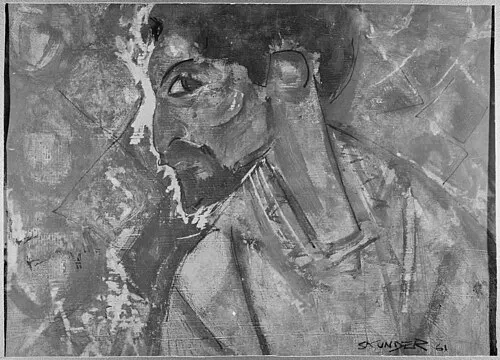
Afewerk was the first winner of the Haile Selassie I Prize for Fine Arts, in 1964, and received many international honours; he was a public figure in Ethiopia, known for his grand robes and his house-studio in Addis Ababa, Villa Alpha. He also designed stamps, murals, mosaics and costumes. He died in Addis Ababa on 10 April 2012, aged 79, though one source gives 80. Later Ethiopian modernists, such as Skunder Boghossian, took a more abstract and experimental path, but Afewerk remained the country's most famous painter.
Where to see the work
Africa Hall, the seat of the UN Economic Commission for Africa in Addis Ababa, is the place to see the windows, and the reopened building has published material on the restoration. Meskel Flower is widely reproduced, and the Villa Alpha studio is described by sources as a museum in itself; check access before visiting. Sotheby's article on modern Ethiopian masterpieces discusses his stained-glass designs and is a good place to read more. His large canvas African Heritage hangs in the art gallery of the National Museum of Ethiopia.
See also
Ethiopian art; Skunder Boghossian; East African art; and our list of Ethiopian artists.