Artist · Nigeria
Yinka Shonibare
Yinka Shonibare (born 1962) is a British-Nigerian artist known for headless mannequins in Victorian dress made of Dutch wax print — a fabric sold across West Africa as "African" though it was developed in Europe for Asian markets. His sculptures, installations, photographs and films about colonialism, class and identity include Nelson's Ship in a Bottle (2010), shown on London's Fourth Plinth, and The British Library (2014).
Updated 3 min read

Between London and Lagos
Yinka Shonibare was born in London in 1962 and grew up in Lagos, speaking Yoruba at home and English at school. At eighteen, back in London to study art, he contracted transverse myelitis, an inflammation of the spinal cord that left him partly paralysed; he has worked with a team of assistants ever since. He studied at the Byam Shaw School of Art and Goldsmiths College.
The fabric of empire
As a student he was asked why he did not make "authentic African art". His answer became his signature material: Dutch wax print, the brightly patterned cotton worn across West Africa and seen in Europe as typically African. Its history is anything but simple: it was developed in the Netherlands, inspired by Indonesian batik, made for colonial markets, and later adopted and reinvented in West Africa. For Shonibare it stands for the tangled, hybrid identities that colonialism produced.
He dresses life-size, headless mannequins in Victorian and eighteenth-century costume tailored from this fabric — aristocrats at play, explorers, a duel — so that the clothes of European power are made from the cloth of its colonies. Scramble for Africa (2003) seats fourteen headless figures around a long table, a reference to the Berlin Conference of 1884–85, where European powers divided up African territory on a map; the missing heads are usually read as a comment on lost identity and humanity.
To see how the trick works, look at the cut as well as the pattern. The costumes are cut like period tailoring, so you read them as Victorian before you read them as African. Then the fabric corrects you: a curator at the Smithsonian's National Museum of African Art has pointed out that the cloth is inspired by Indonesian batik, manufactured in Europe and sold in West Africa. The sculptures only work if you hold all three places in mind at once.
Public works
In 2010 Nelson's Ship in a Bottle, a scale model of HMS Victory with sails of wax print, was shown on the Fourth Plinth in Trafalgar Square, in a bottle 4.7 metres long. It has stood outside the National Maritime Museum's Sammy Ofer Wing in Greenwich since 2012, and you can see it free.
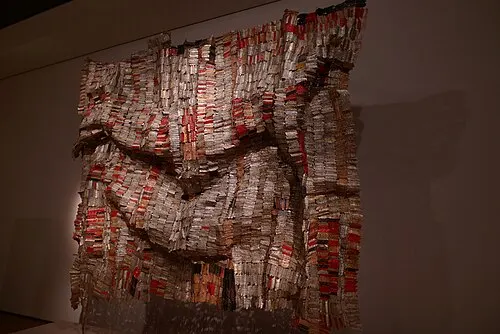
The British Library (2014) fills library shelves with 6,328 second-hand books covered in wax-print fabric. On 2,700 of the spines, gold-foil names pick out immigrants to Britain who made major contributions to its culture, and people who publicly opposed immigration; the other spines are blank. It was first shown in 2014 at Brighton Museum and Art Gallery, commissioned for HOUSE 2014 and the Brighton Festival, then at Turner Contemporary in Margate in 2016, and Tate acquired it in 2019.
His Wind Sculpture series turns the cloth into steel and fibreglass: huge billows of wax-print pattern frozen as if in a gust. Wind Sculpture VII (2016), about six metres tall and finished with gold leaf, is in the collection of the Smithsonian's National Museum of African Art; another stands in Ndubuisi Kanu Park in Ikeja, Lagos, and a third, Wind Sculpture (SG) I, stood in Doris C. Freedman Plaza in New York in 2018.
Recognition and foundations
Shonibare was nominated for the Turner Prize in 2004, elected a Royal Academician in 2013 and appointed CBE in 2019. He runs Guest Projects, a space for other artists in his London studio, and founded the G.A.S. Foundation, with residencies in Lagos and on a farm at Ijebu, in Nigeria.
See also
Otobong Nkanga and Ibrahim Mahama, who also make the materials of trade and empire their subject; contemporary African art; and our lists of Nigerian artists and Nigerian sculptors.
Works
Freely licensed photographs from Wikimedia Commons. Select a picture for the full-size file, its author and its licence.