Painter and musician · Nigeria
Twins Seven-Seven
Twins Seven-Seven (1944–2011) was a Nigerian painter, sculptor, printmaker and musician, the best-known artist of the Oshogbo school. Taking his name from being the only survivor of seven sets of twins born to his mother, he filled dense, intricate works with the spirits, animals and gods of Yoruba folklore. He was named a UNESCO Artist for Peace in 2005.
Updated 3 min read
A name and a story
Taiwo Olaniyi Oyewale-Toyeje Oyelale Osuntoki, known as Twins Seven-Seven, was born in 1944 in Nigeria. He explained his name as a story he loved to tell: his mother had seven sets of twins, and he was the only child to survive. Twins have a special place in Yoruba belief, and so do children who die young: the abiku, spirit children thought to be born only to die and return again. He made that history part of his identity, and in 1973 painted Healing of Abiku Children.
Oshogbo
In 1963 he arrived at the Mbari Mbayo club in Osogbo as a dancer and musician. The workshops run there by the writer Ulli Beier and the artist Georgina Beier encouraged people with no formal art training to paint and draw: participants were given materials, space and encouragement, but no academic instruction. Twins Seven-Seven quickly became the star of what came to be called the Oshogbo school. His works show the spirit world of Yoruba stories, the bush full of ghosts and hybrid creatures that also inspired the novels of Amos Tutuola.
How to look at his pictures
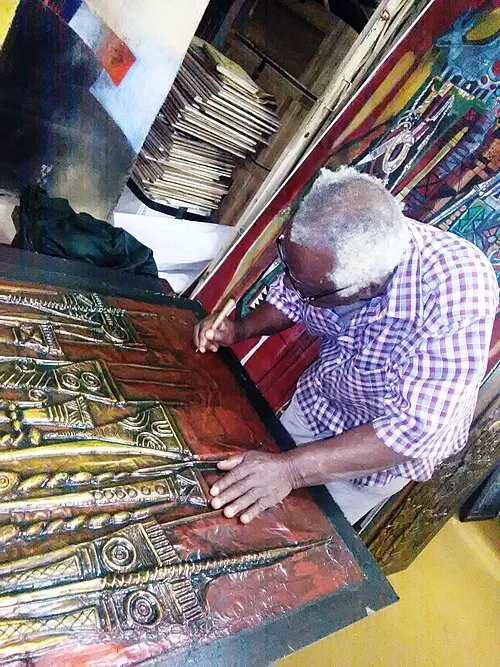
Start with what they are made of. He drew in ink and painted on board, Masonite, paper and even denim, and his best-known works are on plywood: on some he cut openings into one board and mounted it on a second, so that the picture rises in low relief. Then look at the surface. Almost nothing is left empty: bodies, trees and animals are filled with lines, dots, scales and stripes, and figures merge into hybrids, half human and half animal or spirit, with gods among ordinary people. The titles tell the stories, as in Esu-Odara's Giant Domestic Animals, Shade on the Wood (1967), after Esu, the Yoruba messenger god, or Dogo the Kidnapper (1968–69). Not every subject is Yoruba: in The Crucifixion (1976) he painted the Christian story in the same crowded, patterned language, as if it, too, belonged to the world of his spirits. Read them slowly, as you would a page of Tutuola: each picture is a crowded scene from a world where the living, the dead and the spirits share the same space.
Music and the world
He was also a musician and bandleader, and travelled widely, exhibiting and performing in Europe and the United States, where he lived for some years. He became a chief in Ibadan, with the title Ekerin-Bashorun Atunluto of Ibadanland. Ulli Beier, his mentor, recorded long conversations with him, mostly in Sydney in 1984–85, and published them as his autobiography, A Dreaming Life (1999). In 2005 UNESCO named him an Artist for Peace. He died at University College Hospital in Ibadan on 16 June 2011, a few months after Ulli Beier.
Where to see his work
The Brooklyn Museum holds Portrait (1966–67), ink and paint on plywood. The Studio Museum in Harlem has Village Scene (1966) and Esu-Odara's Giant Domestic Animals. The High Museum of Art in Atlanta holds The Crucifixion (1976), oil on plywood, a gift of Dr Richard Long; the Bowdoin College Museum of Art has Shapes in the Sky During Rainy Season (1974), painted on denim; and the Chazen Museum of Art in Madison, Wisconsin, bought Dogo the Kidnapper in honour of the art historian Henry Drewal, a scholar of Yoruba art. Almost all of these date from his first decade as an artist.
See also
Ladi Kwali, the other great Nigerian artist of his generation to work outside the art schools; Ben Enwonwu; and our lists of Nigerian artists and Nigerian painters.