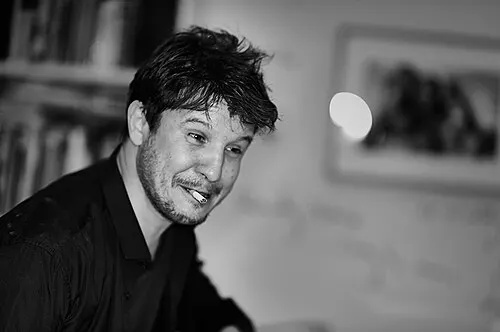
Painter · Cameroon
Nzante Spee
Nzante Spee (1953–2005) was a Cameroonian painter from the North West Region. After training in Nigeria and Côte d'Ivoire, he returned to Bamenda and founded the Spee Art Centre, one of the first art centres in the region, where he trained younger artists such as Angu Walters. His paintings mix cubism, surrealism and naive caricature in crowded, dreamlike scenes he called the "melting age". He died in California in 2005.
Updated 2 min read
Sunday Nzante Spee was born in 1953 in Mbem, in the grassfields of north-western Cameroon. He finished secondary school at the Baptist Missionary College in Bamenda, and from 1976 to 1979 studied fine arts in Nigeria, then continued in Abidjan, Côte d'Ivoire, until 1982, at a time when Cameroon had little formal art education of its own. In 1984 he won the Bastos Prize, awarded for the year's best painting in Cameroon.
Back home he settled in Bamenda and founded the Spee Art Centre, a studio and training centre — possibly the first of its kind in the city. Living from painting was hard there, and he also painted shop fronts, signs and advertisements, decorated public buildings and played guitar in a reggae band. His studio became a school for younger painters, among them Angu Walters: according to one account Walters's mother invited Spee to see what her son was making from the materials he could find, and Spee took him into his workshop and guided him. Walters became one of Cameroon's best-known contemporary artists.
Spee's own pictures are dense and dreamlike: figures, faces, animals and buildings melt into one another in bright colours, mixing the fragmented forms of cubism, the strangeness of surrealism and the humour of caricature, often with comments on Cameroonian society. He called this style the "melting age"; one gallery describes it as a world in which everything crumples, flows and falls apart, like an impression that the world is ending.
How to look at a Spee: do not look for a single scene. Start at one figure and follow it as it melts into the next, and notice where the humour lands. That reading is this site's own. He died in Stockton, California, on 25 May 2005.
Where to see the work
The Galerie Herrmann in Germany publishes a page on his work, and the book Visual Arts in Cameroon: A Genealogy of Non-Formal Training, 1976–2014 places him in the history of Cameroonian art teaching. Ask galleries that handle Cameroonian art what is available. See our list of Cameroonian artists.