Calligraffiti artist · Tunisia
eL Seed
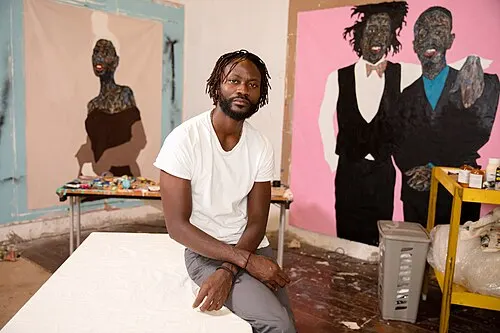
eL Seed (born 1981) is a French-Tunisian artist who combines Arabic calligraphy and graffiti, a style he calls calligraffiti. Born in Paris to Tunisian parents from Gabès, he paints huge messages of tolerance and dialogue on walls around the world. His best-known work, Perception (2016), spreads across some fifty buildings in Cairo's Manshiyat Naser, the district of the city's Coptic rubbish collectors.
Updated 2 min read

eL Seed was born in 1981 in the Paris region (most sources say Paris, one says Le Chesnay) to a Tunisian family from Gabès. He grew up speaking Tunisian Arabic at home but only learned to read and write standard Arabic as a teenager, and calligraphy became his way into the language. He took his name from Le Cid, the French play by Corneille, which he met at school. Starting out in the graffiti scene, he developed a style that blends the flowing letters of Arabic calligraphy with the scale and spray paint of street art: calligraffiti.
In 2012, after the Tunisian revolution, he painted a verse of the Qur'an about mutual respect and tolerance up the 57-metre minaret of the Jara Mosque in Gabès, the first work to bring him wide international attention. In Cairo's Manshiyat Naser, home of the Zabbaleen, the Coptic community that collects and recycles much of the city's waste, he and his team painted Perception (2016) across about fifty buildings in an anamorphic composition. The words, by the fourth-century bishop Athanasius of Alexandria — "Anyone who wants to see the sunlight clearly needs to wipe his eye first" — can only be read as a whole from one point on the nearby Muqattam hill.
His other projects have taken his calligraphy to walls, bridges and public spaces across Europe, the Middle East, Asia and the Americas, including a corridor in Lusail in Qatar documented by Qatar Museums.
How to look at Perception: the message is only legible from one place, so go to the viewpoint and then walk down into the district to see how the letters break across rooftops and walls. Anamorphosis makes seeing a matter of position. That reading is this site's own.
Where to see the work
The Jara Mosque minaret in Gabès and the Manshiyat Naser buildings in Cairo are public works; we have not checked their present condition, so ask locally. See our lists of Tunisian artists and Tunisian painters.