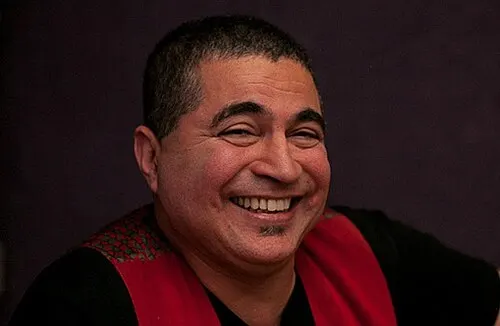
Writer and painter · Morocco
Tahar Ben Jelloun
Tahar Ben Jelloun (born 1944) is a Moroccan writer and painter, one of the best-known authors in the French language and winner of the 1987 Prix Goncourt for La Nuit sacrée. He is known above all for his novels, but he has also painted for many years: bright, colourful canvases shown at the Institut du monde arabe in Paris in 2017 and in a retrospective at the Musée Mohammed VI in Rabat in 2025.
Updated 2 min read

Tahar Ben Jelloun was born in Fez in 1944, went to school in Tangier and studied philosophy in Rabat before moving to France in 1971. His novels — L'Enfant de sable (1985) and its sequel La Nuit sacrée, which won the Prix Goncourt in 1987, among many others — made him one of the most widely read writers from the Maghreb. Most people who search for him are looking for the writer.
He has also painted for years, working with colour and light rather than figures: bright fields, signs and rhythms that recall the walls, doors and textiles of Morocco. In 2017 the Institut du monde arabe in Paris gave him carte blanche for an exhibition, J'essaie de peindre la lumière du monde ("I try to paint the light of the world"), with about fifty works on canvas and paper; it ran from 10 October 2017 to 7 January 2018 and was the first time he had shown his canvases in a French institution, alongside his manuscripts and works by artists he admires. A show of works from 2013 to 2023, Éclat de lumière, followed at the Galerie Delacroix in Tangier in 2023. From 8 April to 30 June 2025 the Musée Mohammed VI of Modern and Contemporary Art in Rabat held a retrospective, De l'écriture à la peinture ("From writing to painting"), with about forty works and ten manuscripts of his novels, and a catalogue with texts by Ben Jelloun, Aziz Daki, Jérôme Clément and Boubker Temli; it was extended after strong attendance. In 2026 L'Atelier 21 in Casablanca showed ten stained-glass pieces made from his paintings. His novel This Blinding Absence of Light (2001) drew on the testimony of Aziz Binebine, a survivor of the Tazmamart prison and brother of the painter and novelist Mahi Binebine.
He has described painting as a source of joy and colour, in contrast to the pain he associates with writing.
How to look at a Ben Jelloun: forget the novels first. The paintings work by colour fields and light rather than figures, so let the colour carry you the way a sentence would. That reading is this site's own.
Where to see the work
L'Atelier 21 in Casablanca represents him, and the Musée Mohammed VI and the Institut du monde arabe have published their exhibitions' catalogues and press kits. Ask each what is on view.
For Moroccan painting more broadly, see the Casablanca School, Farid Belkahia, Chaïbia Talal and our lists of Moroccan painters and Moroccan artists, and our guide to North Africa.