Painter · Algeria
M'hamed Issiakhem
M'hamed Issiakhem (1928–1985) was an Algerian painter, one of the founders of modern Algerian art. At fifteen a grenade explosion killed two of his sisters and a nephew and cost him his left arm. He trained in Algiers and Paris, became the lifelong friend and collaborator of the writer Kateb Yacine, and painted the suffering of war, above all mothers and widows, in a powerful expressionist style. He also designed Algerian banknotes and stamps.
Updated 3 min read

The accident
M'hamed Issiakhem was born on 17 June 1928 in a village in Kabylia, and grew up in Relizane, in western Algeria. In 1943, during the Second World War, he was fifteen when a grenade taken from a military camp exploded in the family home. Two of his sisters and a nephew were killed. Issiakhem survived, but his left arm had to be amputated, and he spent long months in hospital. Accounts differ on details: some sources say the grenade came from a French camp and others from an American one, and one says the arm was lost below the elbow.
The trauma marked his whole life and work. Pain, loss and the bodies of the wounded are everywhere in his painting.
Algiers, Paris and Kateb Yacine
After the war he studied at the school of fine arts in Algiers from 1947 to 1951, including miniature painting with Omar Racim, and in 1951 he met the young writer Kateb Yacine, author of Nedjma. It was the start of a friendship that lasted until the painter's death: the two worked together on books, theatre posters and films, and were known as the "twins of Nedjma".
From 1953 to 1958 he studied at the École des Beaux-Arts in Paris. During the war of independence he lived between France and Germany, and in 1962, the year Algeria became independent, he returned home and worked as a cartoonist for the newspaper Alger Républicain.
The painting
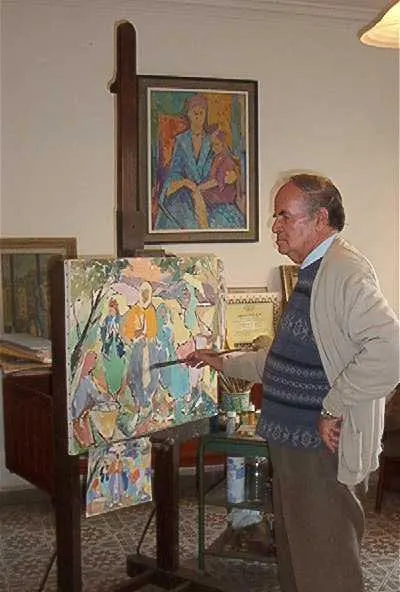
Issiakhem was an expressionist. His canvases are dark and heavily worked, built up with thick layers of paint that he scraped, scratched and reworked; figures emerge from them half-formed, with deep-set eyes. His great subject was the suffering of the Algerian people in war: mothers holding children, widows, the women who waited and grieved. He also painted haunting portraits.
How to look at an Issiakhem: look at the surface before the subject. The scraping and reworking are visible, and they make a painting feel dug out of its ground rather than laid on it. Then find the figure, which often emerges only slowly from the paint. That reading of how he worked comes from the descriptions of his technique and is this site's own.
Like his friend Mohammed Khadda, he wanted a modern Algerian art that was free of colonial exoticism; but where Khadda turned to abstraction and signs, Issiakhem stayed with the human figure.
A national artist
In independent Algeria he taught at the school of fine arts in Algiers and in 1963 was a founder of the national union of plastic arts. He designed Algerian banknotes and stamps, so his work passed through the hands of millions; Numista's catalogue of coin and banknote designers lists a 5-dinar note among his works. In 1980 he received the Simba d'or (Golden Lion) in Rome, a prize for African art supported by UNESCO. A 1980 painting, Femme et mur (Woman and Wall), is among the works listed in his later years.
He died in Algiers on 1 December 1985, aged 57.
Friendship with Kateb Yacine
Kateb Yacine, who is credited with introducing him to theatre set design, remained his closest collaborator. Algerian press accounts describe the two as inseparable from their first years in Paris; the friendship lasted until Issiakhem's death in 1985.
Where to see the work
The Musée national des Beaux-Arts d'Alger lists La Mendiante and Mère inconnue in its collection, and a catalogue for a 2010 exhibition was published by the national museum of modern and contemporary art in Algiers. Ask both museums which works are on display, since displays change.
See also
Mohammed Khadda and Bachir Yellès, his contemporaries; the Algerian painter Baya; our guide to North Africa; and our lists of Algerian artists and Algerian painters.